The sacred idiom
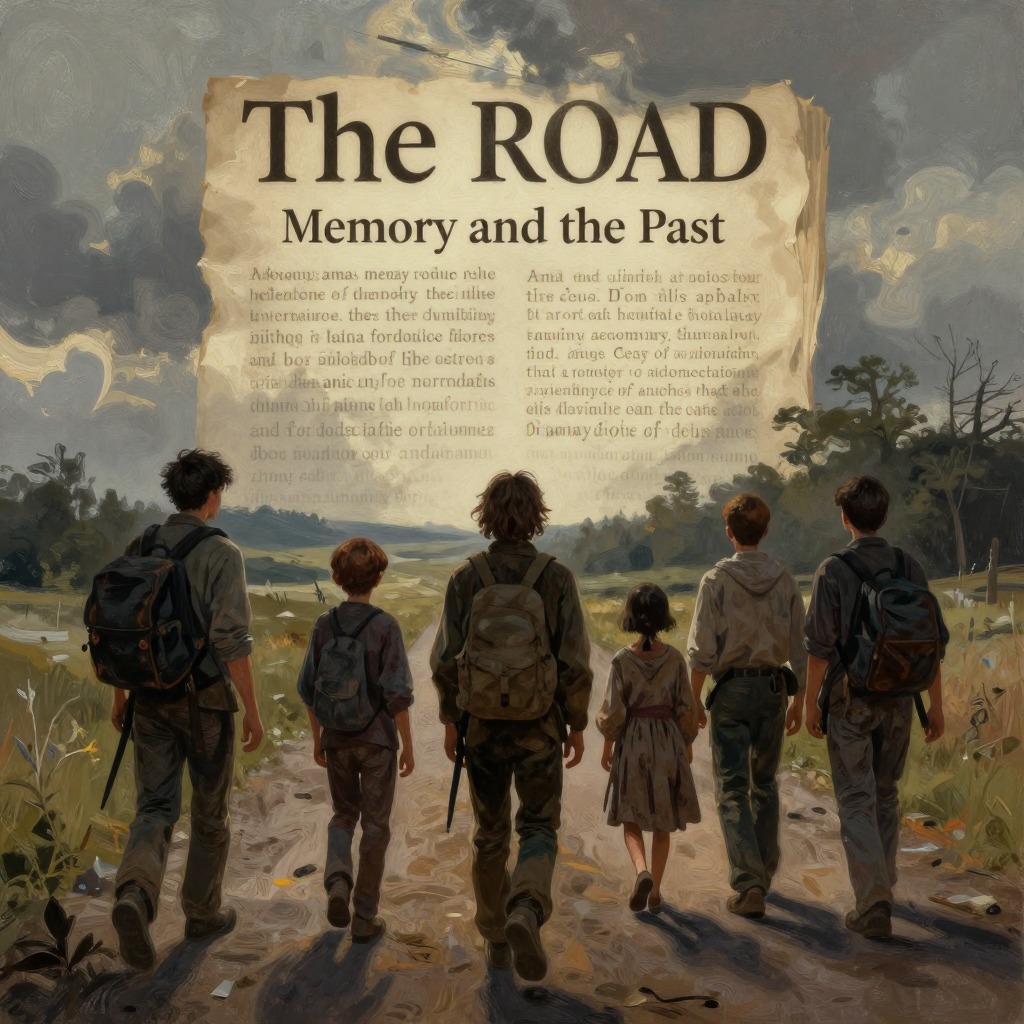
The sacred idiom is a central philosophical concept in Cormac McCarthy's The Road, describing the progressive erosion of language as the world's physical and social referents vanish. It represents the moment when words lose their connection to the things they once named, leaving only a hollow, meaningless shell. This linguistic decay mirrors the broader collapse of civilization, memory, and moral order, and it becomes a measure of how much of the old world has been irretrievably lost.
Definition and Nature
The sacred idiom is introduced as the language of a world that no longer exists. The man reflects that the world is "shrinking down about a raw core of parsible entities. The names of things slowly following those things into oblivion. Colors. The names of birds. Things to eat. Finally the names of things one believed to be true. More fragile than he would have thought. How much was gone already? The sacred idiom shorn of its referents and so of its reality." This passage defines the concept: the sacred idiom is not a specific language but the entire inherited vocabulary of human experience, now stripped of the objects, actions, and truths it once described. The loss is progressive, starting with concrete nouns (colors, birds, food) and moving to abstract beliefs, revealing the fragility of all linguistic meaning.
The Collapse of Referents
The novel repeatedly illustrates how the physical world's destruction has rendered language obsolete. The man and the boy travel along "the road," but the road is no longer a conduit for travel or commerce; it is a gray, ash-covered path through a dead landscape. The "grocery cart" is no longer a tool for shopping but a lifeline for carrying salvaged goods. The "map" is a tattered, disintegrating document that no longer corresponds to any recognizable geography. The man once carried a "billfold" until it wore a hole in his trousers, then discarded its contents—money, credit cards, a driver's license, a photograph of his wife—on the blacktop, as if they were gaming cards from a game no one plays. These objects have lost their original functions, and their names have become empty signifiers.
The Persistence of Ritual and Naming
Despite the collapse of the sacred idiom, the man and the boy continue to use language, often in ritualistic or desperate ways. The man teaches the boy the names of things, even as those things disappear. He explains the "dam" and its purpose, though the lake is dead and the turbines will never turn again. He tells the boy about "crows" and "Mars," acknowledging that neither exists anymore. The boy asks, "There's not any crows. Are there?" and the man replies, "No. Just in books." This exchange highlights the gap between the word and the world: the sacred idiom survives only as a memory, preserved in stories and lessons that have no living referent. The man's act of naming becomes a form of mourning, a way to hold onto a world that is gone.
The Sextant as a Counter-Example
A rare moment of intact meaning occurs when the man discovers a brass sextant on the wrecked sailboat Pájaro de Esperanza. He lifts it from its fitted case and is "struck by the beauty of it." The sextant is a tool of navigation, a device that once connected sailors to the stars and the horizon. In the post-apocalyptic world, it has no practical use—the sky is perpetually overcast, and there is nowhere to sail to. Yet the man holds it and turns the wheel, and it is "the first thing he'd seen in a long time that stirred him." The sextant retains its form and function, a perfect artifact from a world that understood its own coordinates. Unlike the sacred idiom, which has been "shorn of its referents," the sextant still points to a system of knowledge, even if that system is now unreachable. It represents a kind of language that has not yet been emptied of meaning, a fragile exception to the general decay.
The Bunker's Canned Goods as a Linguistic Archive
When the man and the boy discover the bunker, they find "crate upon crate of canned goods. Tomatoes, peaches, beans, apricots. Canned hams. Corned beef." The labels on these cans are the last remnants of the sacred idiom in its commercial form: words like "pears" and "peaches" still correspond to actual food, still nourish the body. The boy asks, "Can you read it? Pears. That says pears." The man confirms, "Yes. Yes it does. Oh yes it does." In this moment, the sacred idiom is briefly restored: the word and the thing are reunited. The bunker is a time capsule of the old world's language, a place where the referents still exist. But the man knows this is temporary; the cans will eventually be empty, and the words will once again float free of meaning.
The Final Silence
The sacred idiom's ultimate fate is silence. After the man dies, the boy is left alone with the pistol and the memory of his father's words. He talks to his father every day, but the conversation is one-sided, a "talk that you imagine." The language of the old world has become a private liturgy, spoken by a single child in a dead landscape. The novel's final image—the brook trout in the mountain streams, "maps of the world in its becoming"—is a vision of a world before language, a world of "mystery" that hums without words. The sacred idiom has been shorn of its referents, and what remains is not language but the memory of language, a ghost that the boy carries with him into an unknowable future.